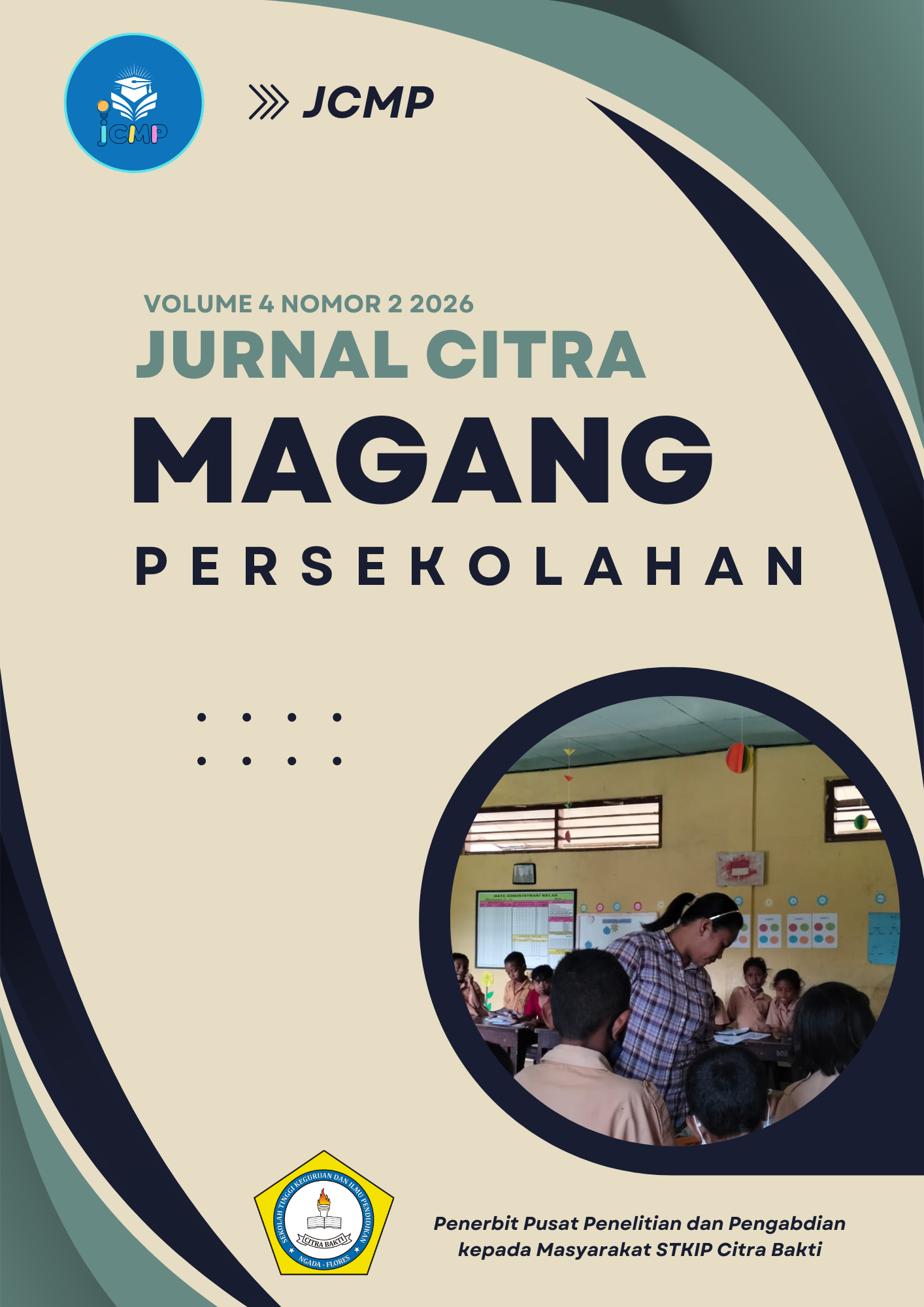
PENGUATAN SUASANA BELAJAR MENGAJAR YANG KONDUSIF UNTUK MEWUJUDKAN SEKOLAH SEHAT DI SD
DOI:
https://doi.org/10.38048/jcmp.v4i2.6862Keywords:
Suasana Belajar Kondusif, Sekolah Sehat, Sekolah Dasar, Lingkungan BelajarAbstract
Penelitian ini dilatarbelakangi oleh pentingnya suasana belajar mengajar yang kondusif sebagai dasar dalam mewujudkan sekolah sehat di sekolah dasar. Lingkungan belajar yang bersih, aman, nyaman, dan didukung interaksi sosial yang positif berperan penting terhadap efektivitas pembelajaran dan perkembangan peserta didik. Penelitian ini bertujuan untuk mendeskripsikan dan menganalisis peran SDK Wolopogo dalam penguatan suasana belajar mengajar yang kondusif demi mewujudkan sekolah sehat. Penelitian menggunakan pendekatan kualitatif dengan metode deskriptif. Subjek penelitian meliputi kepala sekolah, guru, dan peserta didik yang dipilih secara purposive. Data dikumpulkan melalui observasi, wawancara, dan dokumentasi, kemudian dianalisis melalui reduksi data, penyajian data, verifikasi, dan penarikan kesimpulan. Hasil penelitian menunjukkan bahwa SDK Wolopogo berperan aktif melalui penyediaan lingkungan belajar yang bersih dan sehat, penerapan pembelajaran interaktif, penanaman nilai kebersihan, serta kolaborasi antara sekolah, siswa, dan orang tua. Disimpulkan bahwa penguatan suasana belajar yang kondusif mendukung terwujudnya sekolah sehat secara berkelanjutan.
References
Addie, O. (2025). The status of water and sanitation facilities in public primary schools in Oyo State, Nigeria: Progress toward achieving the SDG 6. Environmental Health Insights, 19, 11786302251332045. https://doi.org/10.1177/11786302251332045
AlAli, R., Al-Barakat, A., Alrosaa, T., Alotaibi, S., Abdullatif, A., & Almughyirah, S. (2025). Science education and environmental identity: An integrative approach to fostering sustainability practices in primary school students. Sustainability, 17(19), 8883.
Aldridge, J. M., & Blackstock, M. J. (2024). Assessing students’ perceptions of school climate in primary schools. Learning Environments Research, 27(3), 579–602. https://doi.org/10.1007/s10984-024-09492-2
Bick, S., Davies, K., Mwenge, M., MacLeod, C., Braun, L., Chipungu, J., Chidziwisano, K., & Dreibelbis, R. (2025). WASH and learn: A scoping review of health, education and gender equity outcomes of school-based water, sanitation and hygiene in low-income and middle-income countries. BMJ Global Health, 10(5), e018059. https://doi.org/10.1136/bmjgh-2024-018059
Bick, S., Ezezew, A., Opondo, C., Leurent, B., Argaw, W., Hunter, E. C., Cumming, O., Allen, E., & Dreibelbis, R. (2024). Impact of a school-based water and hygiene intervention on child health and school attendance in Addis Ababa, Ethiopia: A cluster-randomised controlled trial. BMC Medicine, 22, 348. https://doi.org/10.1186/s12916-024-03558-x
Dan, B. A., Kovács, K. E., Bacskai, K., Ceglédi, T., & Pusztai, G. (2023). Family-SEN school collaboration and its importance in guiding educational and health-related policies and practices in the Hungarian minority community in Romania. International Journal of Environmental Research and Public Health, 20(3), 2054. https://doi.org/10.3390/ijerph20032054
Donaldson, C., Morgan, K., Ouerghi, S., Lewis, J. J., & Moore, G. (2025). Associations of perceived school and year group climate with mental health among children aged 7-to-11 years. Child Indicators Research, 18(2), 885–904. https://doi.org/10.1007/s12187-024-10213-7
Elizondo-González, J. F., Malla, S., & Barros-Bustos, S. (2025). Multilevel determinants of school belonging: The moderating role of national safety climate. Frontiers in Education, 10, 1697010. https://doi.org/10.3389/feduc.2025.1697010
Granato, C., Campera, M., & Bulbert, M. (2025). Active learning affects children’s intention to act and awareness of the importance of nature and understanding environmental change. World, 6(2), 36. https://doi.org/10.3390/world6020036
Harrington, S., Mulville, M., & Stravoravdis, S. (2023). The relationship between ventilation rates in schools and the indoor airborne transmission potential of COVID-19. Architectural Engineering and Design Management, 1–18. https://doi.org/10.1080/17452007.2023.2263519
Koivuhovi, S., Kilpi-Jakonen, E., Erola, J., & Vainikainen, M.-P. (2025). Parental involvement in elementary schools and children’s academic achievement: A longitudinal analysis across educational groups in Finland. Research in Social Stratification and Mobility, 95, 101007. https://doi.org/10.1016/j.rssm.2024.101007
Li, X., Kuo, Y.-L., & Huggins, T. J. (2024). Perceived feedback and school belonging: The mediating role of subjective well-being. Frontiers in Psychology, 15, 1450788. https://doi.org/10.3389/fpsyg.2024.1450788
Mucherah, W., Finch, W. H., Bota, K., Bowles, H., & Thomas, R. (2024). Classroom climate, teacher support and self-agency: Perceptions of students with and without disabilities. International Journal of Disability, Development and Education. https://doi.org/10.1080/1034912X.2024.2403387
Obermeier, R., Pösse, L., Schlesier, J., & Gläser-Zikuda, M. (2026). Students’ school-related well-being and parental involvement over time: Trajectories and interrelations in the context of the first year in secondary school. Children and Youth Services Review, 183, 108804. https://doi.org/10.1016/j.childyouth.2026.108804
Sharma, M. K., Adhikari, R., Khanal, S. P., Acharya, D., & van Teijlingen, E. (2024). Do school water, sanitation, and hygiene facilities affect students’ health status, attendance, and educational achievements? A qualitative study in Nepal. Health Science Reports, 7, e2293. https://doi.org/10.1002/hsr2.2293
Susanti, P., Oktariani, N. L. R., Putra, I. K. S. A., Dharmayudha, I. P. I., & Werang, B. R. (2024). Pengaruh ketersediaan sarana dan prasarana sekolah terhadap motivasi belajar siswa SD. JPG: Jurnal Pendidikan Guru, 5(3), 310–318. https://doi.org/10.32832/jpg.v5i3.15666
Yin, Y., Su, Q., & Li, S. (2024). School belonging mediates the association between negative school climate and depressive symptoms among Chinese adolescents: A national population-based longitudinal study. Frontiers in Psychology, 15, 1368451. https://doi.org/10.3389/fpsyg.2024.1368451
Yli-Pietilä, R., Soini, T., Pietarinen, J., & Pyhältö, K. (2024). How is students’ well-being related to their class teacher’s professional agency in primary school? European Journal of Psychology of Education, 39, 2341–2361. https://doi.org/10.1007/s10212-023-00781-7